Part 3 jump to main content.
Preamble
In late June 2026, my 50th birthday celebrations were put on hold as my partner’s parents decided on an extended trip to Europe, perhaps their last, for which I was volunteered to chauffeur us around Northern Italy for 2 weeks during one of the most intense heatwaves since the week I was born.
Her mum was determined to see all cinque of the Cinque Terre villages and some of Milan’s popular tourist sites. Her dad came along for the ride, perhaps watching more table tennis and political clickbait on his iPad than the historical sites, and asking why there was only Italian food when Singapore had much more variety (The Three Amigos anyone?). We, on the other hand, braced ourselves for a fortnight of underwhelming coffee; after many previous trips to Italy and over a decade holidaying in France, we were mentally prepared.
With two weeks to fill, my only stipulation was that we start with a few days in Tortona, home of my favourite grape: Timorasso, the grape and region that spurred me to start writing about wine.
I knew I’d naturally set myself ad-hoc side missions to seek out lesser-known native grapes in every subsequent destination.
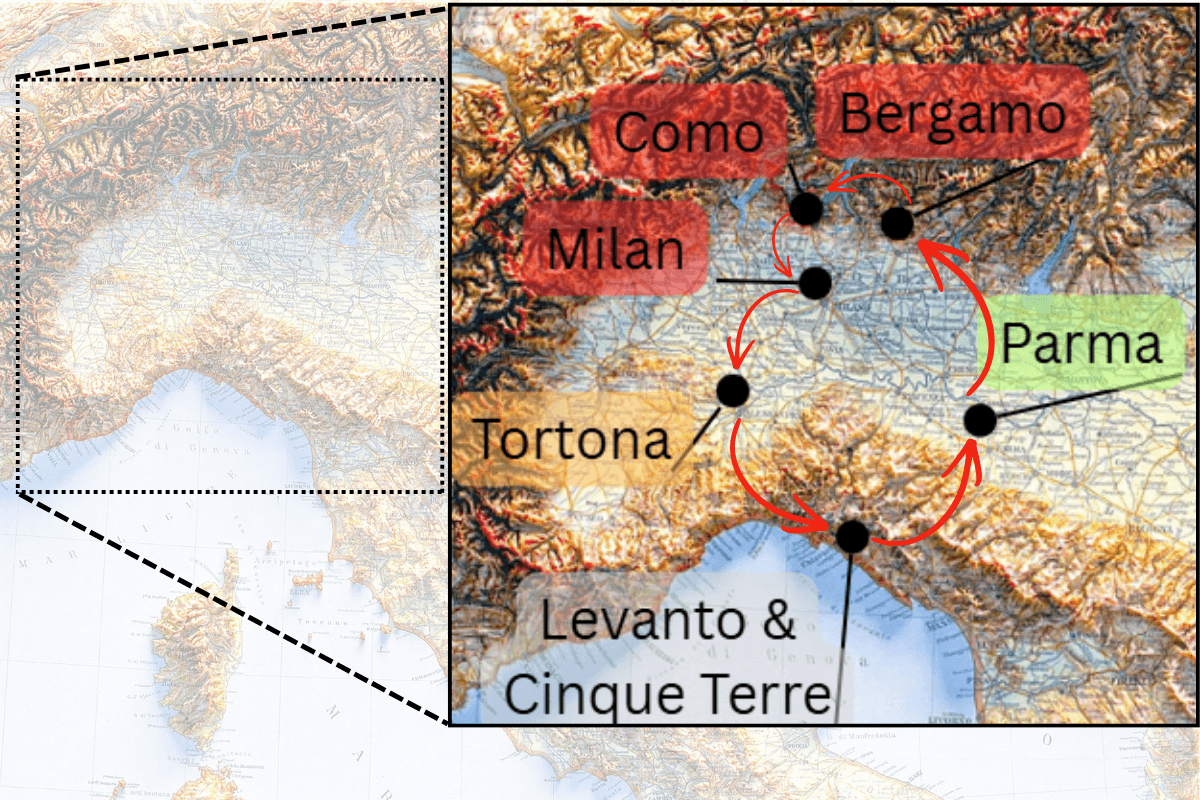
The Itinerary: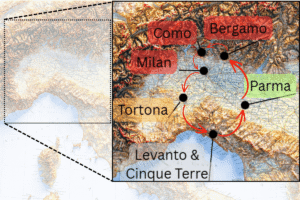
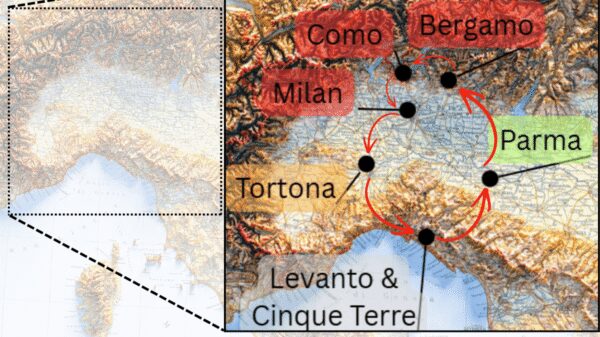
- Tortona (Piemonte) – starting off in one of my happy places in Italy, exploring Derthona Timorasso wines and seeing familiar faces.
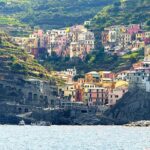
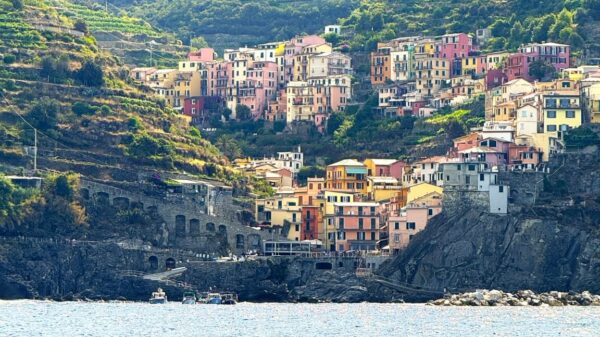
- Levanto (Liguria) – a seaside town as a base to explore the villages of Cinque Terre (and seek out the local grapes Bosco, Vermentino Nero and rarer Rossese Bianco and Piccabòn)
- Parma (Emilia-Romagna) – I knew about the ham. Other than that, it was a good base to visit Japanese winemaker Shun Minowa and discover some of the 17 Lambrusco clones such as Grasparossa.
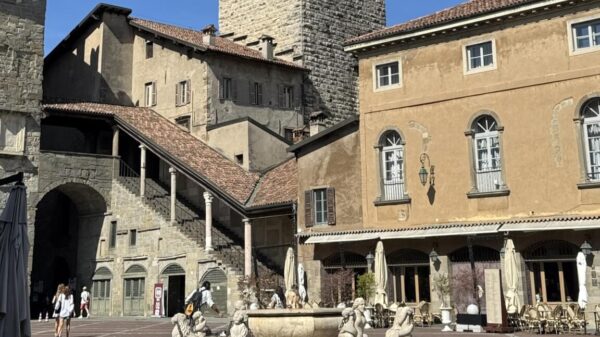
- Bergamo (Lombardy) – a relatively arbitrary choice based on its location, the appeal of an old town, and an opportunity to taste the rare grapes Moscato di Scanzo (also Italy’s smallest DOCG) and Erbanno
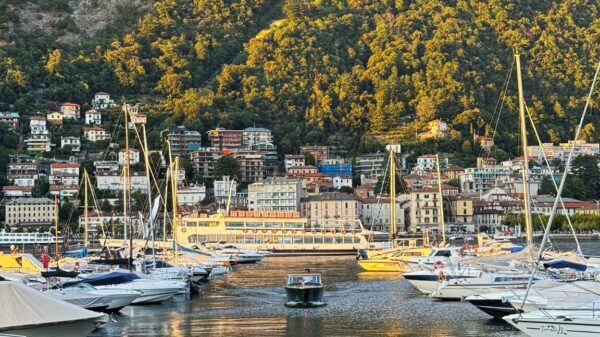
- Como (Lombardy) – chosen as I naively thought it would be cooler in the mountains, and its proximity to the airport to return the hire car. I also discovered the relatively rare local grape Verdese
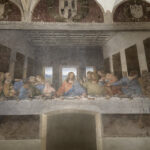
- Milan (Lombardy) – The Last Supper, Milan Duomo and that fancy shopping arcade next to it were on the bucket list for our visitors. I was also able to track down one of the few bottles of Cascina Lieto’s Moscato in Milan, from Japanese winemaker Hiroto Sasaki.
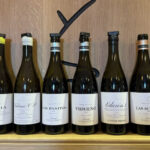
My wine haul can be seen on Instagram here.
Emilia-Romagna’s wines and lesser-known grapes
- DOC(G)/IGTs: The region has 2 DOCGs, 19 DOCs and 9 IGPs. Details on these can be found on the excellent resource: italianwinecentral.com
- Main grapes: there are many international grapes (Chardonnay, Cabernets, Merlot etc) but the main regional grapes are the Labrusca varieties and Ortrugo, Malbo Gentile, Marzemino, Ancellotta and Fogarina,
- Lambrusco grapes are more a family of grapes than a specific variety (perhaps a bit like Malvasia and Muscat in that sense?). These include Lambrusco Barghi, Benetti, del Pellegrino, di Sorbara, Grasparossa, Maestri, Marani, Montericco, Oliva, Salamino and Viadanese..
- Food of note : Parmigiano Reggiano, Prosciutto di Parma (Parma ham) and the even more prestigious Culatello di Zibello (fancier ham) are all famed produce from Parma. Unfortunately it turns out that my childhood nostalgic sweets, Parma Violets, are in fact a British brand with no relation to Parma.
Other local fayre can be quite horsey and offal, lots of tripe, intestines and horse meat on the menus.
- Recommended wine spots in Parma: Enoteca Tabarro, La Piricucca, Vineria Giramondo, Croce di Malta, Tra L’uss e L’asa
Day 7 – Arrival in Parma and exploring their wine bars
Parma lies about 1/4 the way across Emilia-Romagna region (i.e. towards the west).
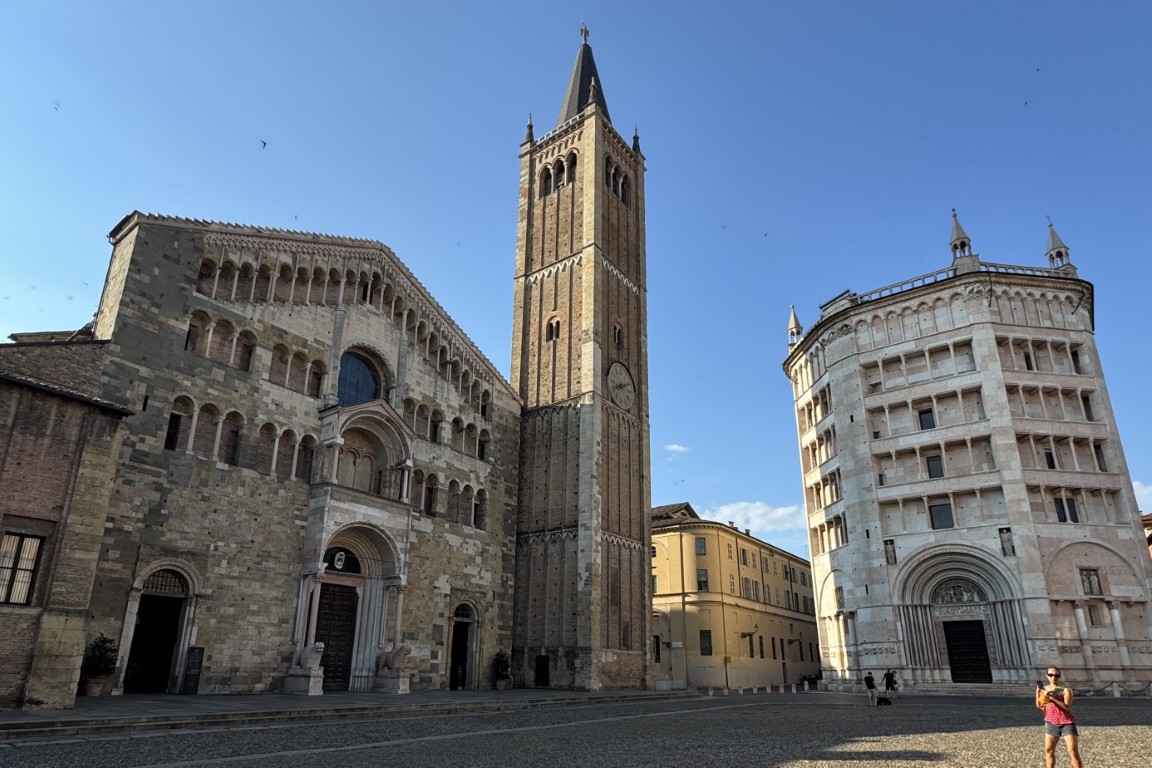
I often believe that a lasting impression of a place can rely on the initial approach. Arrive in town via the industrial outskirts, and it can taint your view of an otherwise beautiful town. Our first impressions of Parma were quite charming. Not too big. Not too busy. Pretty architecture and a laid-back vibe.
We had arranged an appartement-style accommodation to share with Amanda’s parents at the very pleasant Palazzo Dalla Rosa Prati (map). The staff gave us excellent instructions (including “ignore the no entry sign” etc) to the hotel to drop off the parents and luggage and give us further directions to the car park. While about 60 metres away as the crow flies, reaching the car park required a full circle around a quarter of the town centre and a mini-labyrinth in which to get lost in our spaceship.
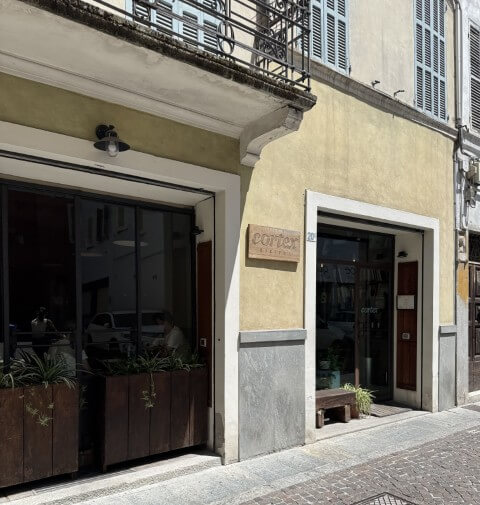
Then we went straight out to the nearest place we could find on the Raisin app: Cortex.
Lunch at Cortex Bistro
Cortex Bistro (map) is a pleasant restaurant with a mix of Italian and Asian-fusion dishes and a focus on natural wines.
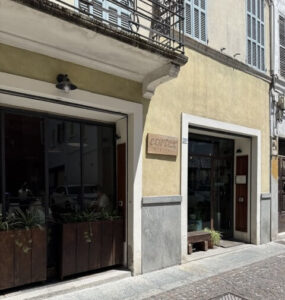 It took less than 2 minutes from arrival to me blurting out to the manager that I wrote a book on Japanese Wine, or maybe that I was visiting a Japanese producer nearby (Shun Minowa). It turns out that they know Shun well, and one of the kitchen staff is Japanese. She was promptly summoned to say hello, and we exchanged friendly , but self-conscious pleasantries in Japanese with mild embarrassment on both sides.
There weren’t very many others at the restaurant. A table of two, and an Asian tourist travelling alone.
As Asians, the Puns (my partner’s family) love guessing where other similar-looking folk may be from. However, they lack any of the social anxiety associated with things like pointing, staring or verbalising their inner dialogue, asking loudly “I wonder where she’s from, she looks Asian”. Compounded by an Aussie tendency towards the more direct, and less “politically-correct” language, I find myself cowering behind the wine list on such occasions.
I did take the opportunity to ask the manager (Ottavia? Or was that another recommendation I scribbled in my notebook) for recommendations for that evening. The top of which was Tabarro, one of Italy’s first natural winebars, and who’s founder was currently outside, dining at their on-street tables with friends. I left him in peace to enjoy his meal.
After lunch we took a walk around town, which was smaller than we expected (perfect given the hot temperatures) with only a limited amount of places open.
Hoping to wake ourselves up a little, we went to a coffee joint that billed itself as serving “speciality” coffee. It turns out that this meant quite heavily-roasted beans from a single country of origin, prepared in a dizzying array of milk and flavour combinations – more akin to an international chain than anything truly
specialty. The following days we opted instead for a rather pricey
cappuccino con dopio caffè at
Gran Caffè Cavour.
Aperativo at Tabarro
Enoteca Tabarro is, I am told, one of the first natural wine bars in Italy, after which many others modelled themselves. That would make it “iconic” in my book.
It opened on 20 December 2005, founded by Diego Sorba, who has a PhD in Irish Literature, but a bigger passion for natural wine and artisanal cheeses.
The shelves are stacked with natural wines, the cellar even more so, and there’s a regularly changing menu of by-the-glass options, and some random open bottles taken from the cellar and replaced with others once finished.
Diego is still involved (a silent partner?), while the wine bar is managed by a new team, the head of which you’d be forgiven for mistaking as Irish.
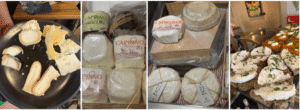
What impressed me the most at Tabarro was the cheese selection. Personally, I find that most Italian cheeses are more “ingredients” than something to be savoured alone on a cheese plate, as you would French cheeses. Diego, however, spent years tracking down some of the country’s best artisanal cheeses, mostly raw milk, to serve at Tabarro. These include a fresh goats’ cheese that was one of the best I have had in Italy, and Montebore from Tortona, one of my favourite wine regions.
On the way home, we stopped by
Officina Alimentare Dedicata to make a dinner reservation for the following night. Since it came recommended by several people, I overlooked the abruptness of the staff (although I did literally walk away, leaving Amanda to deal with the attitude) and lack of aircon. When we enquired about whether they had aircon, the server seemed to increase the attitude to 1980s Alitalia disgruntled air-hostess level.
Day 8 – Piacenza – Shun Minowa, a Japanese winemaker in Italy
I got a morning coffee at the Gran Caffè Cavour, chosen for its proximity and general old-school café vibe rather than the quality of the coffee or brioche. “Brioche” seems to be the catch-all term for breakfast pastries in Italy (someone will surely correct me if I’m wrong here). Mainly “croissants” which are traditionally pumped full of flavoured cream at time of order. The wholemeal croissant (without pumped cream) was decent enough, and compared to the anaemic sandwiches and stale pizza siting in the lunch counter, I counted myself lucky.
Suitably caffeinated, I set off for the first time by myself in the spaceship without Amanda to wave her arms around, guiding me through the tight corners, with only my smartphone for directions and a podcast for entertainment. The destination – Shun Minowa.
In my book, Japanese Wine, I include nearly 30 Japanese winemakers around the world with one of the few in Italy located about 1 hour outside Parma (part of the reason for staying here).
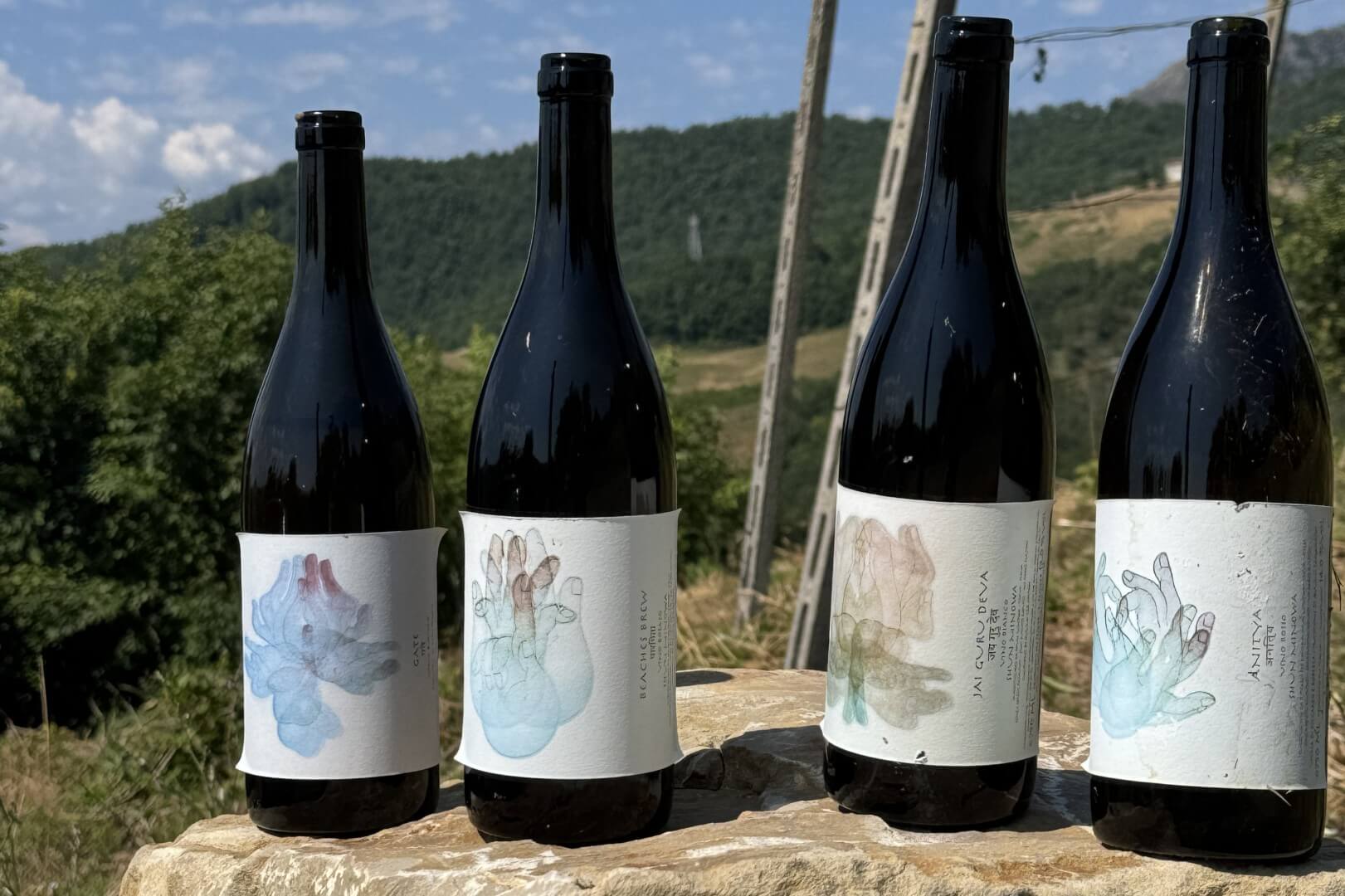
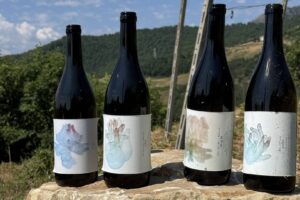 Arriving at the winery, I stopped at the top of the driveway to take a photo of the wine bottles lined up with a backdrop of the valley, hearing “nice view, isn’t it?” behind me as Shun had sneaked up behind me in his car.
Full details of the visit are available on my blog post Shun Minowa; Vignaiolo
After a tour of the vines, winery and barrel tastings, Shun and his wife Erika invited me to join them for lunch in their garden, while Chloe (their adorable rescue dog) concluded the visit by serenading us, harmonising with the siren of a passing fire truck.
Back in Parma
Aperativo at Tra l’uss e’lasa
Right behind the hotel was another natural wine bar I wanted to check out: Tra l’uss e’lasa run by an older couple who have been there, done that and bought the t-shirt. Service can be slow, but is friendly and attentive when it arrives, and there was aircon inside to avoid the outside heat and passive smoking. Definitely a great place worth checking out if you’re in town.
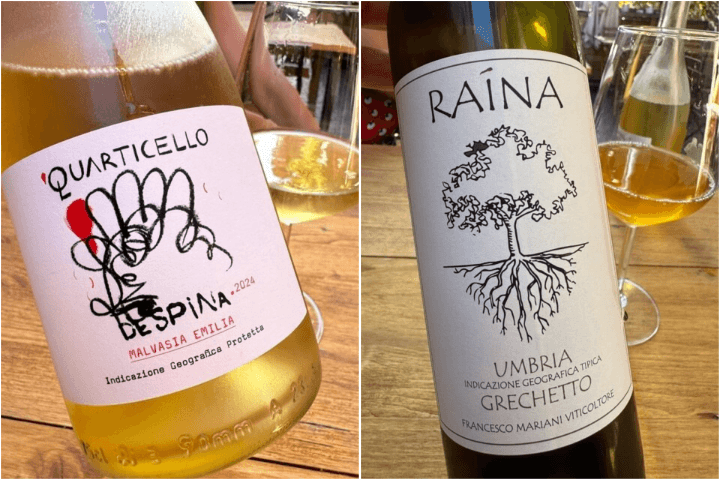
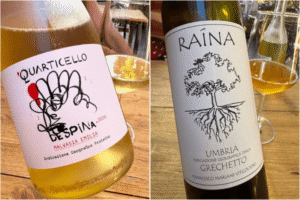 We had a glass of
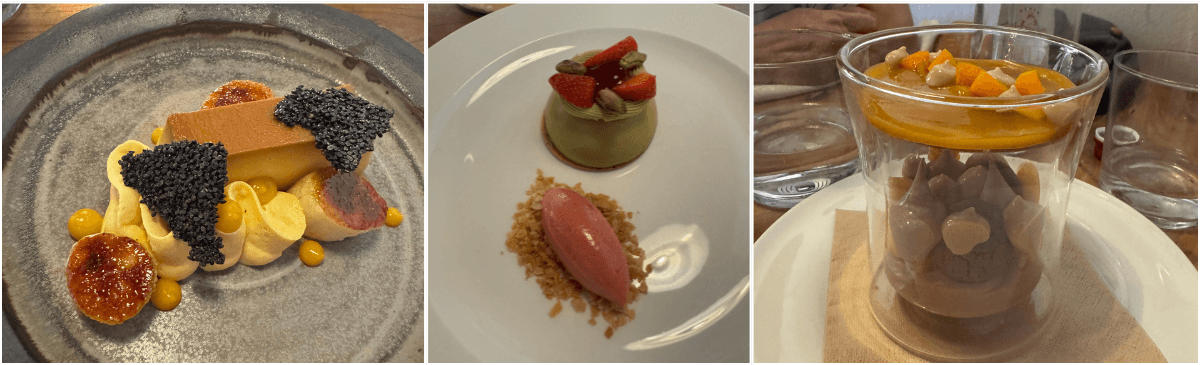
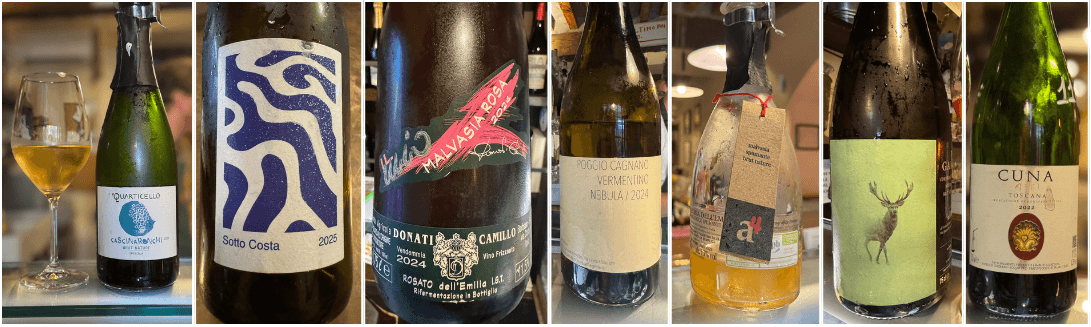
- Despina 2024, Quarticello : A simple refreshing pét-nat with unripe peach flavours
- Umbria Grechetto 2024, Raína : Lovely, juicy, clean and refreshing natural wine with 9 months in acacia barrels. Light skin tannins, light stone fruit compote flavours.
Dinner at Officina Alimentare Dedicata
Dinner was an ordeal from start to finish. Perhaps the server couldn’t cope with the heat. She certainly couldn’t cope with the inconvenience of us turning up 5 minutes before our reservation time (“you’re early!” she barked disapprovingly) despite service having already started. Amanda found her to be less abrupt with the females, and to be fair, some of the other staff were very pleasant. But, to be honest, I’m not sure I’d return.
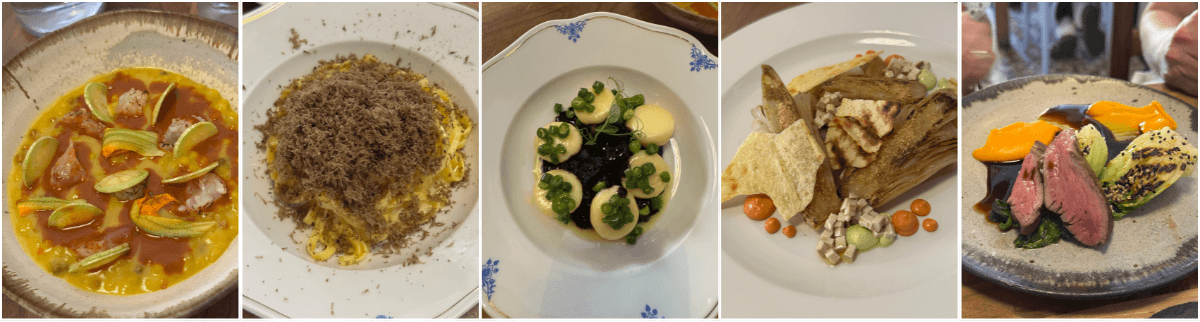
The food was ok (a bit meaty). We were too hot to eat much. or commit to a bottle of wine, opting for a glass instead while we almost developed RSI, wafting the folding fans we had brought with us.
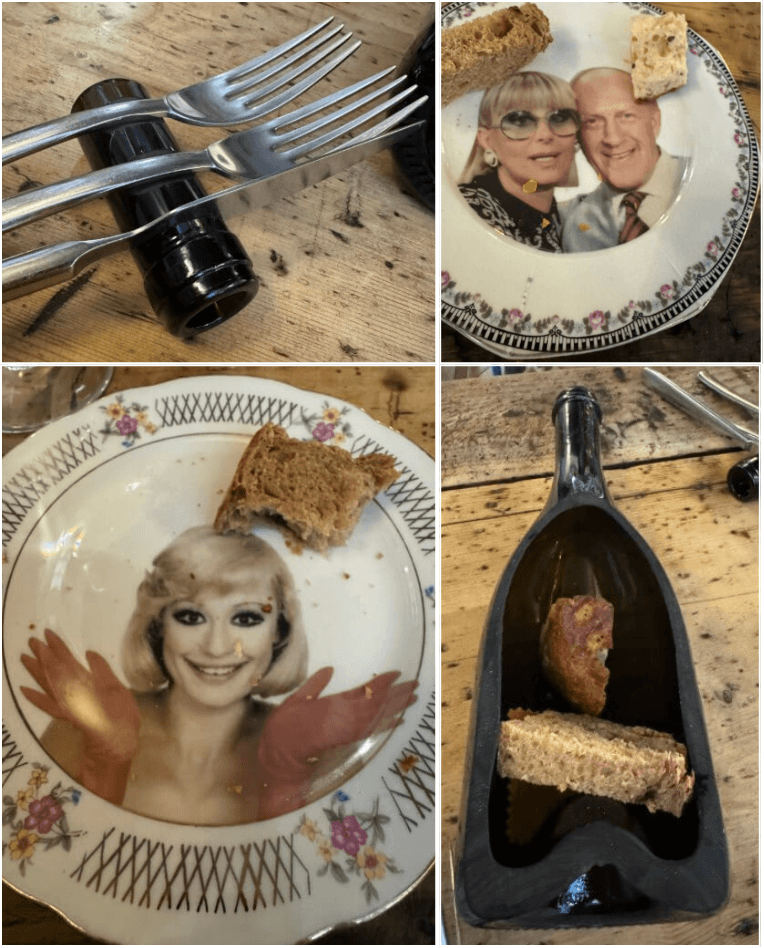
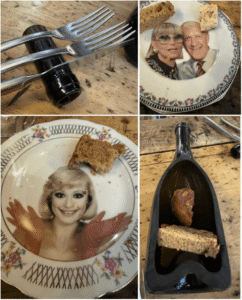
I did enjoy the kitsch plates and the repurposed wine bottles, upcycled as a bread basked and cutlery holders.
Leaving the parents off at the hotel we returned to Tra l’uss e’lasa to cool down over a beer, but not before I took out a bit of my frustration at a group of “yoofs” I saw littering while loitering on the steps of the alley off Piazza del Duomo. I gave them a disapproving stares and a minor telling off in English. Needless to say, the litter was still there the next morning
Next stop (part 4 of 6), Bergamo famous for its old town and having Italy’s smallest DOCG: Moscato di Scanzo (also the name of the grape) – I had my grape mission!

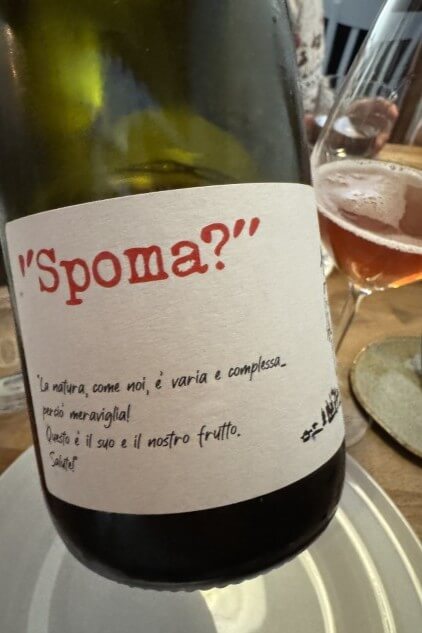 Frizzante “Spoma?” 2023 from Angol d’Amic – an Emilia IGP from near Modena.