
No Comments
The Japanese Wine Industry (NTA 2024)
Updated information from the book “JAPANESE WINE”
available from Amazon and Wine Fogg
The state of the Japanese Wine industry
(NTA report for 2024)
In late March 2025, the Japanese NTA (National Tax Agency) released the results from the 2024 survey of the liquor industry. Questionnaires are sent out to producers, and since 2014, detailed information on the wine industry has been recorded, covering cultivation of wine grapes (grapes intended for eating are not included, even if the same grape variety), wine production, sales and export. See the end of this article for several discrepancies to be aware of.
This latest survey experienced the largest compliance of survey responses so far, with 83% response rate covering 76% of wineries (392 responses from 474 questionnaires sent out). The preceding 3 years received 67-73% response rates covering 60-68% of wineries.
Note all stats refer to “reported” rather than “actual” figures, as of 31 December 2024.
Headlines
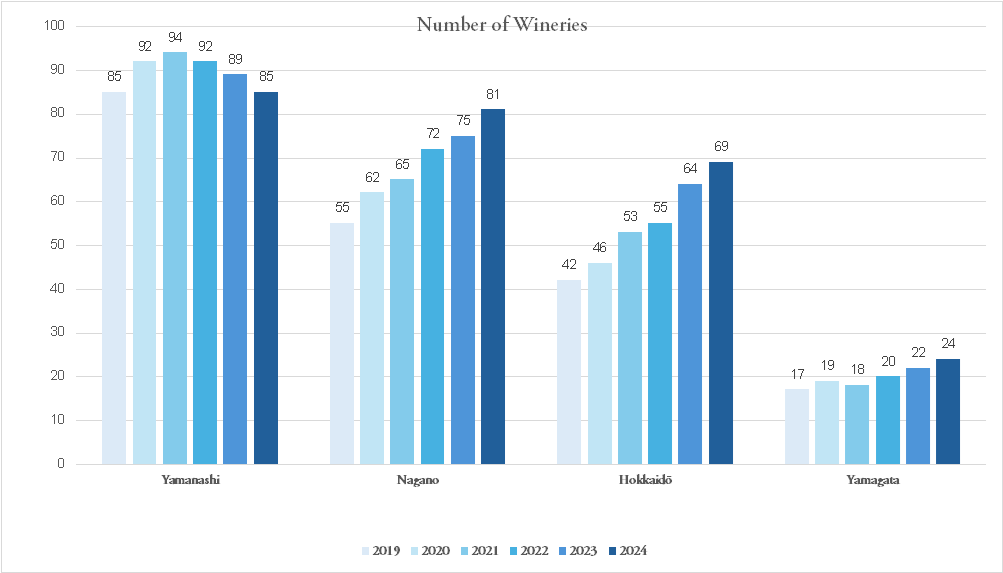
- The number of wineries has increased from 493 (2023) to 519 (2024), estimated to be around 560 in 2025
- Overall wine production continues to decline, driven largely by the decline of “domestic wine” from imported grapes/grape must
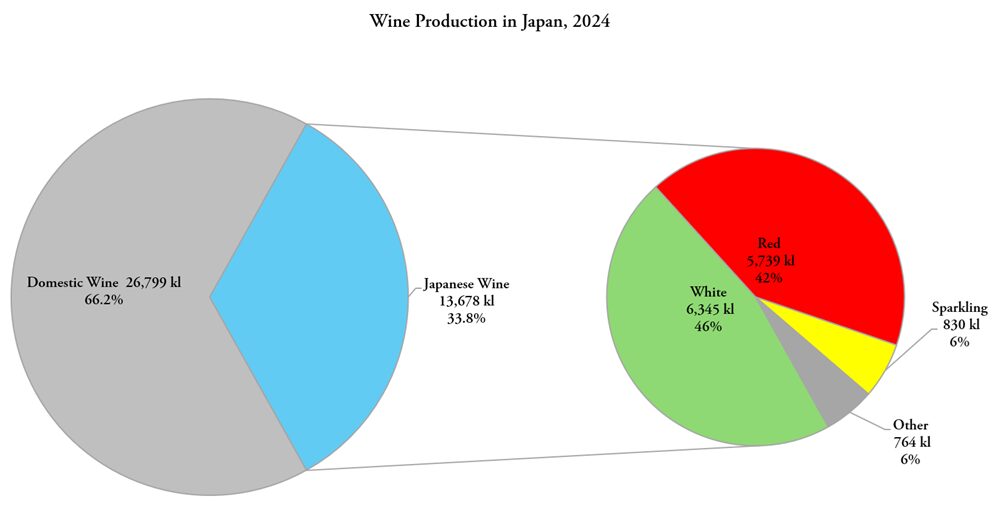
- “Japanese Wine” 日本ワイン decreased slightly by around 5% from 14,324 kl in 2023 to 13,678 kl in 2024
- Cultivation (or use) of Vitis labrusca grapes has declined, particularly in Hokkaidō, while European Vitis vinifera wine grapes continue to increase, particularly in Hokkaidō and Nagano
- Nagano has once again taken 2nd place in the ranking for total wine grapes cultivated and vinified, driven by Hokkaidō’s sharp decline in the use of labrusca grapes
Consumption
The NTA does not report on consumption data, however the OIV reports a total of 327 million litres consumed in 2025 (vs 309 , a growth of 5.8% however this includes both imported and domestic wines
Number of Wineries
Yamanashi wineries continued to decline (however, 2025 may have hit an historical high). Other top regions increased by 8-9%.
Wine Grapes
Cultivation & Vinification
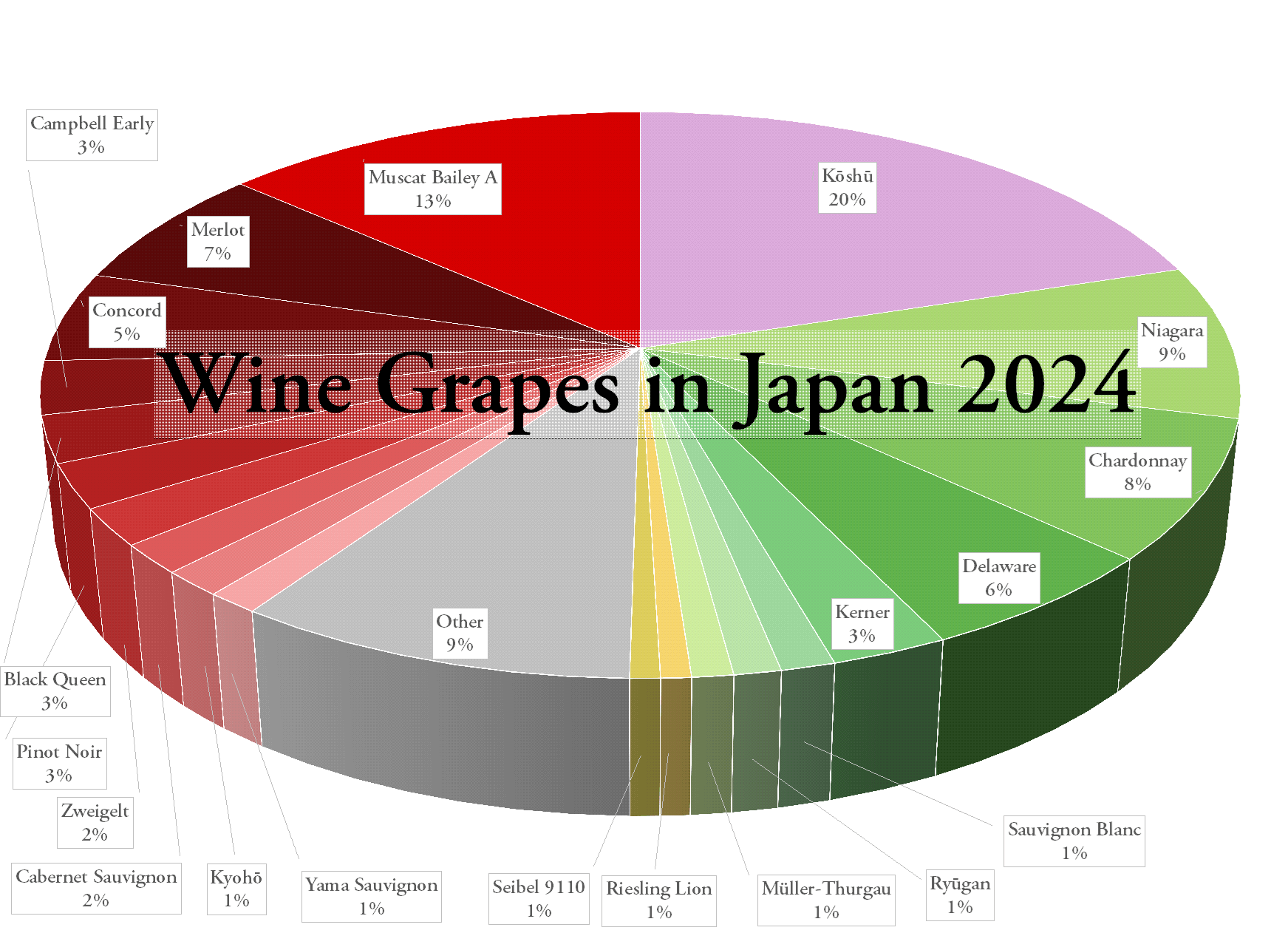
North American Vitis labrusca grapes are being used less in wine production. It is unclear from the figures whether this is due to fewer being grown due to retiring farmers, or a choice of wineries to focus on fine wines.
There has been an increase in Vitis vinifera wine grapes, particularly Pinot Noir, Zweigelt & Kerner (Hokkaidō), and Chardonnay & Ryūgan (Nagano).
Overall 9% fewer grapes were vinified, although it is not clear whether this is 9% fewer cultivated, or 9% fewer used.
By Prefecture
Yamanashi grew 6% fewer and vinified 14% fewer than 2023, possibly influenced by the closure of Sapporo Beer’s Grande Polaire Katsunuma Winery as they consolidated production at their Okayama factory. It now accounts for 28% of total wine (historically around 30%)
Rumour has it that Grand Polaire’s Katsunuma facility will be taken over by Chateraise Belle Foret
Although the cultivation and vinification of grapes has reduced, no doubt the result of ageing and retiring farmers, and shift in production to other prefectures. However, anecdotally, have no doubt that this is being offset by an increase in higher quality wines, particularly from grapes grown at higher altitudes in Hokuto and Nirasaki, the eastern slopes of the basin, and Fujikawaguchiko.
Nagano increased by around 9%, now accounting for 22% of total Japanese Wine (historically 19-25%). Fewer Concord grapes were cultivated there was a 34% increase in Chardonnay and 60% in Ryūgan.
Hokkaidō cultivated 8% fewer grapes and vinified 17% fewer than the previous year, driven mainly by labrusca grapes.
It now accounts for 16% of total Japanese Wine produced (historically 15-25%)
Hokkaidō’s reduction is driven by the decline in labrusca grapes used to make wine (if these are still grown, but sold for eating, they do not appear in the wine stats), particularly Niagara, Campbell Early and Portland, as well as the hybrid Rondo.
Yamagata both grew and vinified 19% more grapes, reporting an increase of 61% in cultivation of Muscat Bailey A (MBA), almost offsetting the decline of MBA in Yamanashi. This is likely the result of global warming and the move of certain grape varieties to cooler climates at higher altitudes (Nagano) and latitudes (Hokkaidō & Yamagata)
The rest of the country cultivated 34% fewer wine grapes, however, wine production remained stable, further suggesting the influence of a large winery like Grande Polaire consolidating production in Okayama (further reinforced by Yamanashi vinifying fewer grapes than it grew for the first time).
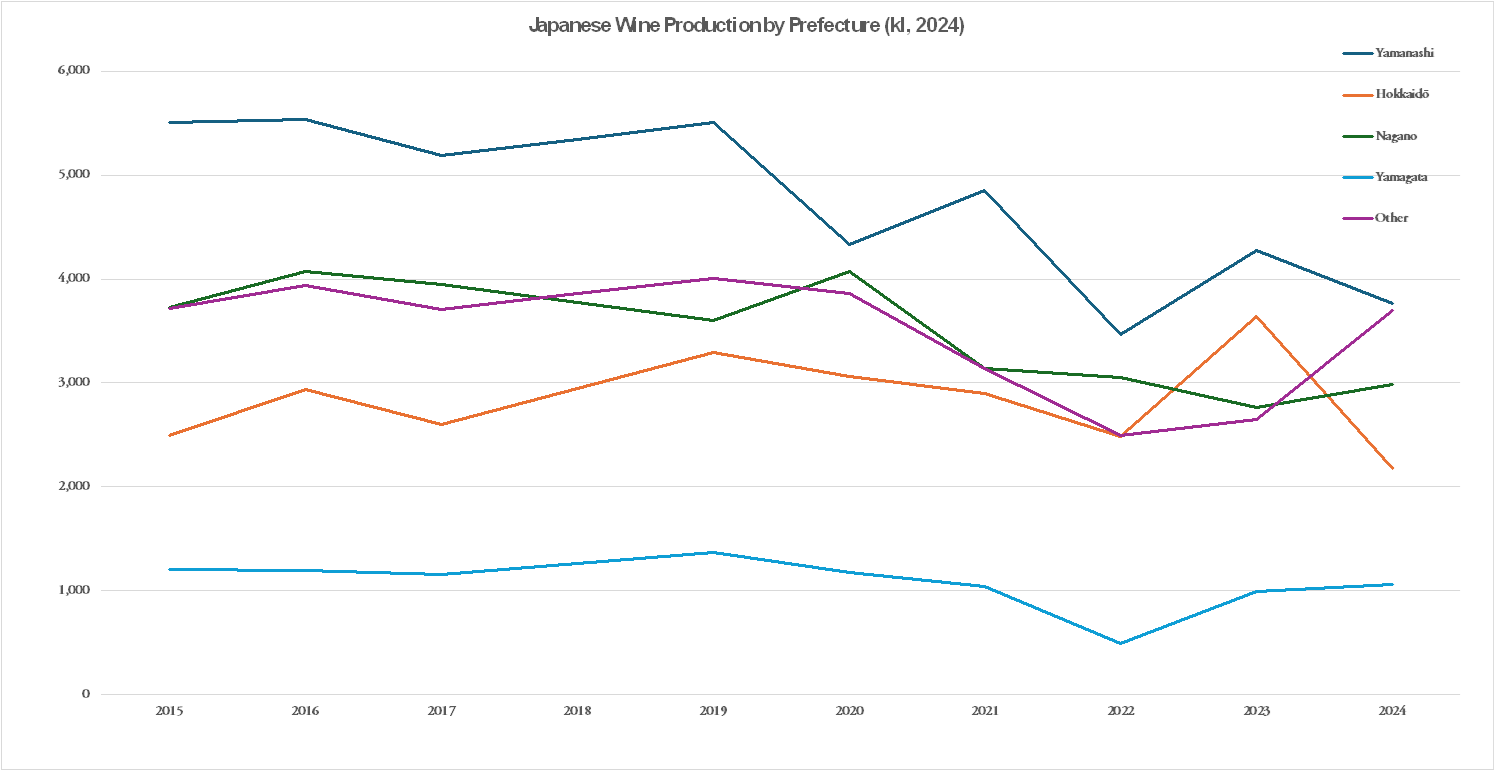
Note: 2021 2022 figures were during covid where there could have been a decline in cultivation / production and/or poor response to the survey
By Grape
White Grapes
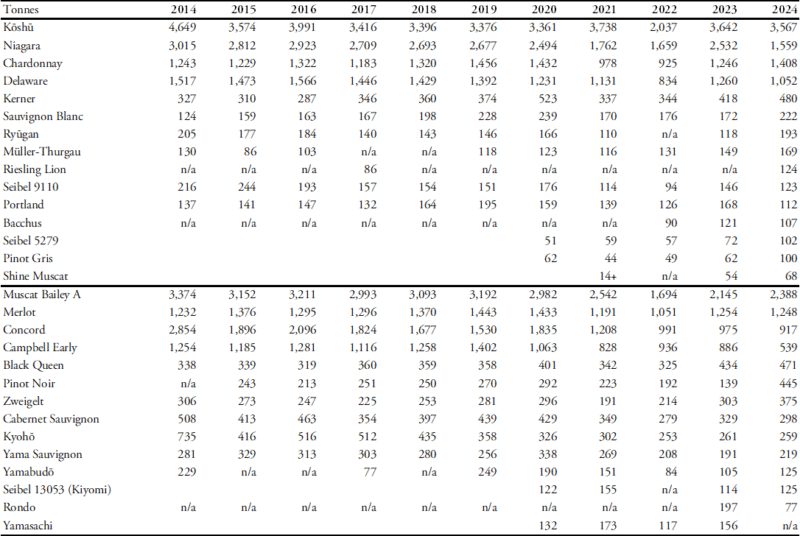
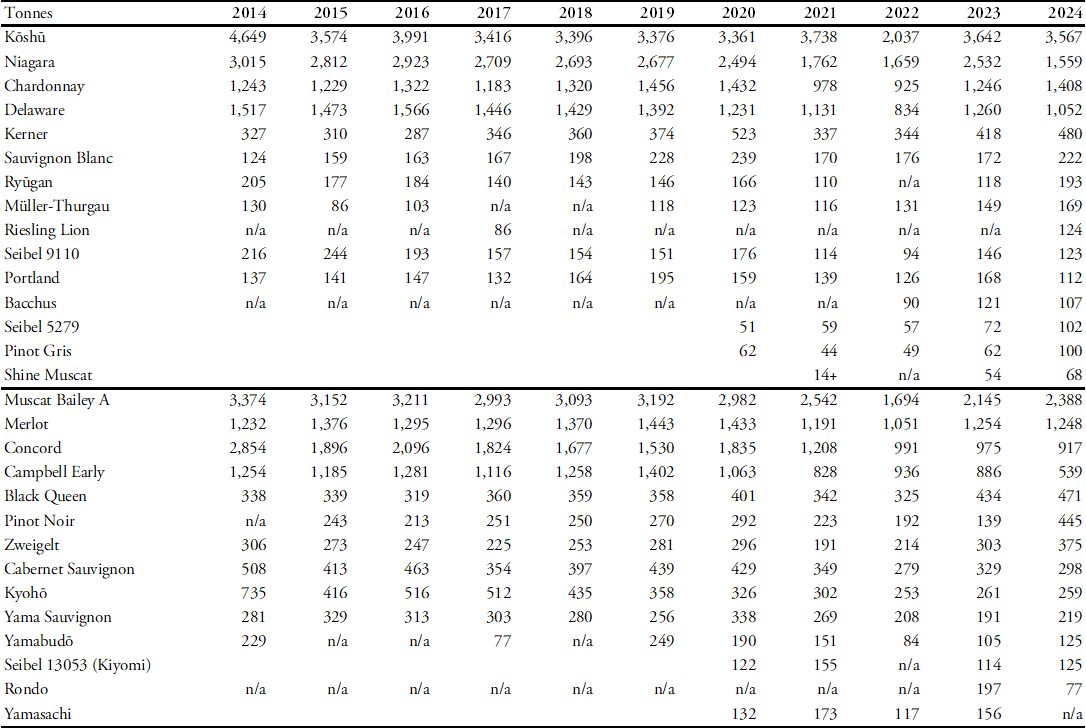
- Chardonnay‘s 13% increase was driven by an additional 115 t in Nagano
- Niagara saw a sharp decline, driven by in Hokkaidō from 1,657 t (2023) to 693 in 2024.
- Delaware saw a noticeable decrease, with Yamagata cultivating 22% less than in 2023
- Sauvignon Blanc continues to increase in coexporoler climates with Yamanashi also cultivating more than previous years
- Ryūgan cultivation is increasing and it once again back in the top 10 most cultivated white wine grapes
- Muscat Bailey A is still grown mainly in Yamanashi, however is declining with Yamagata reporting an increase of around the same quantity suggesting climate change effects
Red Grapes
- Merlot remained stable with Nagano and Yamagata dominating cultivation and production.
- Pinot Noir saw a huge increase of 306 t, of which Hokkaidō accounted for over 60% and Nagano around 20%
- Concord is still grown predominantly in Nagano although down from 975 t (2023) to 917 t (2024)
- Campbell Early declined sharply, mainly in Hokkaidō with over 30% less than 2023 (888 t vs 539 in 2024)
- Zweigelt increased strongly by about 20%, mostly in Hokkaidō 287 t (2023) to 350 t (2024)
- Cabernet Sauvignon saw a reported decline of 10% vs 2023
- Yama Sauvignon is going strong with a 15% increase vs 2023
- Rondo has fallen by 61% from 197 t to 77 t – which makes sense anecdotally when Hokkaidō can grow premium Pinot Noir and high quality Zweigelt.
Production
Production continues to decline with 40,477 kl wine produced vs 81,655kl, driven by the decline in “domestic wine” from imported grapes or grape must.
Japanese Wine 日本ワインdeclined only slightly from 14,324 to 13,678 kl, a decline of 5% in volume, which could equally be an error in reporting.
(see pie charts above under Headlines section)
Styles
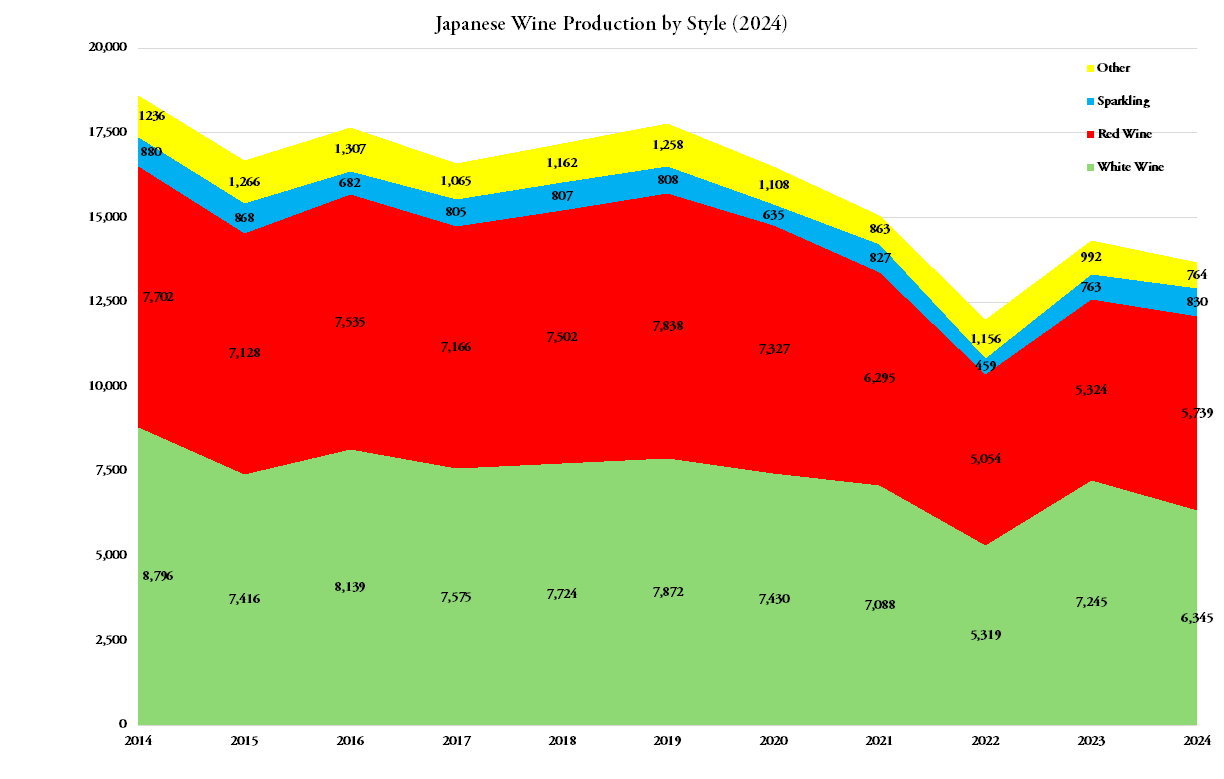
White wine production decreased by 12% while red and sparkling increased by 8-9%
However, as a percent of total wines, this is in line with historical average, with 2023 seemingly disproportionately white-focused.
Exports
Exports – continued to grow (172kl vs 120kl the previous year) with Asia leading the way, accounting for over 60% of all exports.
There was an increase in non-GI wines, suggesting a greater variety of wines from different regions are being exported. Off the top of my head, I expect the natural wine scene outside of the major producing areas are contributing to this rise such as Tochigi’s Coco Farm and Okayama’s Domaine Tetta.
The USA saw the highest growth of 164%, followed Singapore (162%), China (91%) and Taiwan (73%). The Hong Kong market remained stable.
All this to me suggests that Japan remains Asia’s flagship wine producing region, and countries in the region look to Japan when they want to drinking (relatively) local. That said, my knowledge of the Chinese wine market is very limited.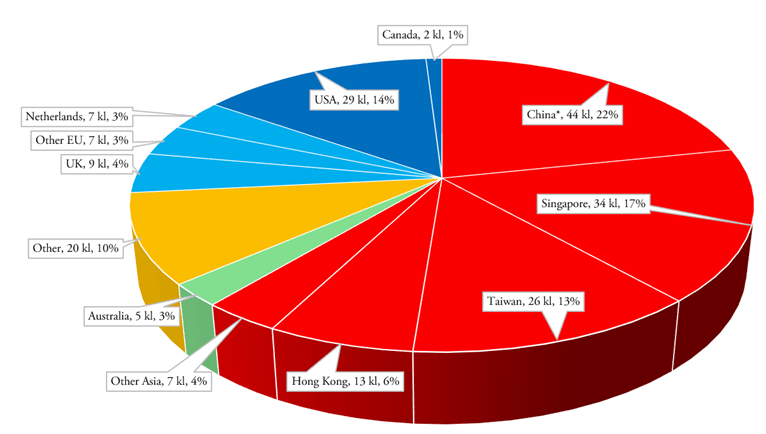
Links to the official reports:
Reiwa 2-7 (2019-2024): https://www.nta.go.jp/taxes/sake/shiori-gaikyo/seizo_oroshiuri/index.htm
Heiwa 17-30 (2004-2017 although true wine stats only go back to 2014):
https://www.nta.go.jp/taxes/sake/shiori-gaikyo/seizogaikyo/09.htm
No report was complied in Reiwa 1 (my stats take the average of the 2017 & 2019)
Discrepancies
The above figures are dependent on the quality of the information received by the NTA by the responses to the survey. Not all surveys are returned, and those that are, are not always complete.
It is worth bearing in mind that:
- 86% of surveys were returned
- A single winery could be anything from a boutique producer of under 10,000 bottles capacity, or a huge winery producing more than 1 million bottles a year
- Some survey questions deal with tonnes of grapes cultivated, received or vinified, while others report kl of wine produced
- Some charts report sales, while others report production. Note that not all wine is sold in the year the grapes are harvested
- Where possible, I have used the tonnes of grapes harvested / processed and avoided using sales figures other than in export quantities







)
&description=&image=https://winefogg.com/wp-content/uploads/NTA-2024-grapes-pie-1024x755.png)